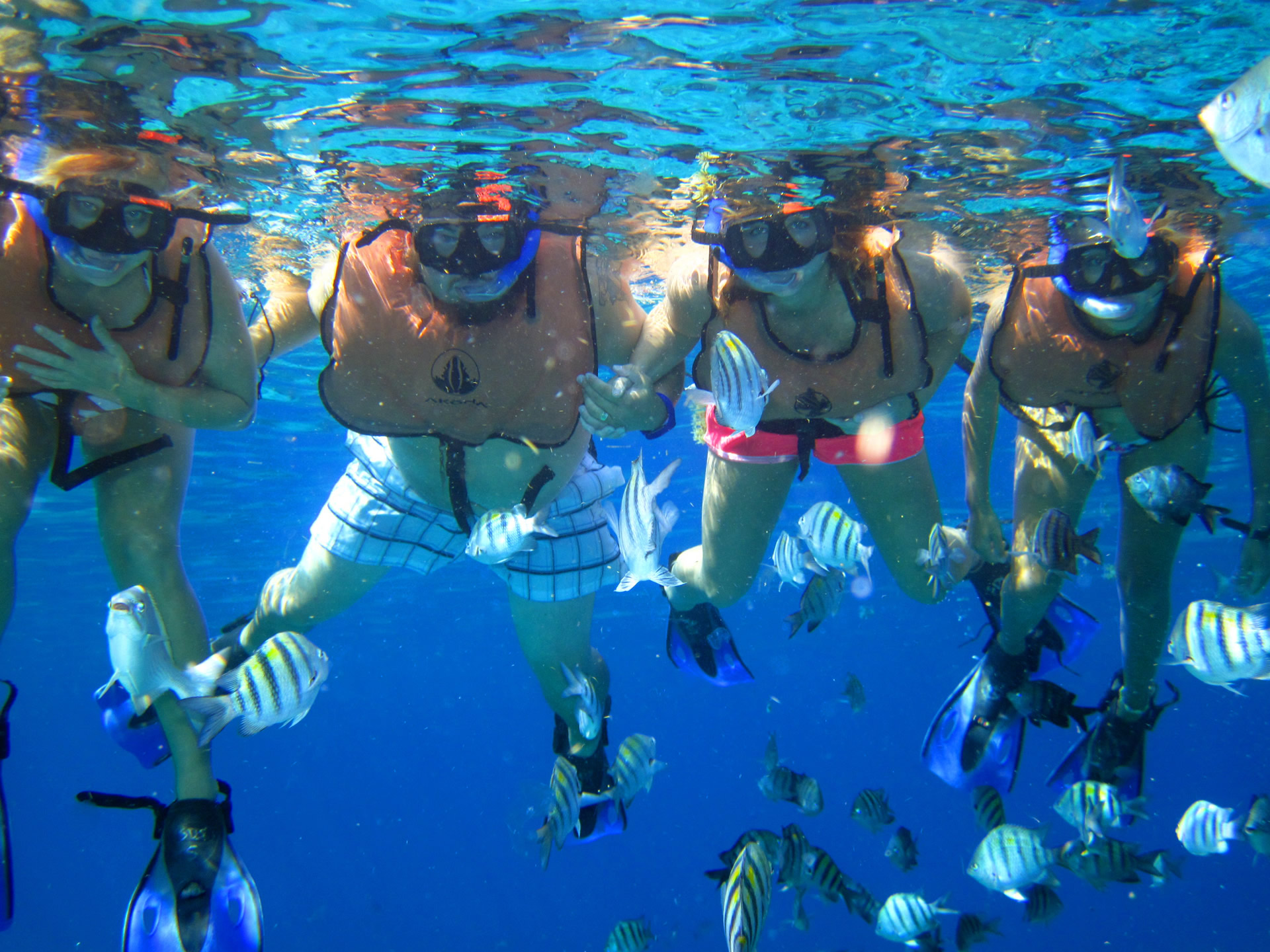
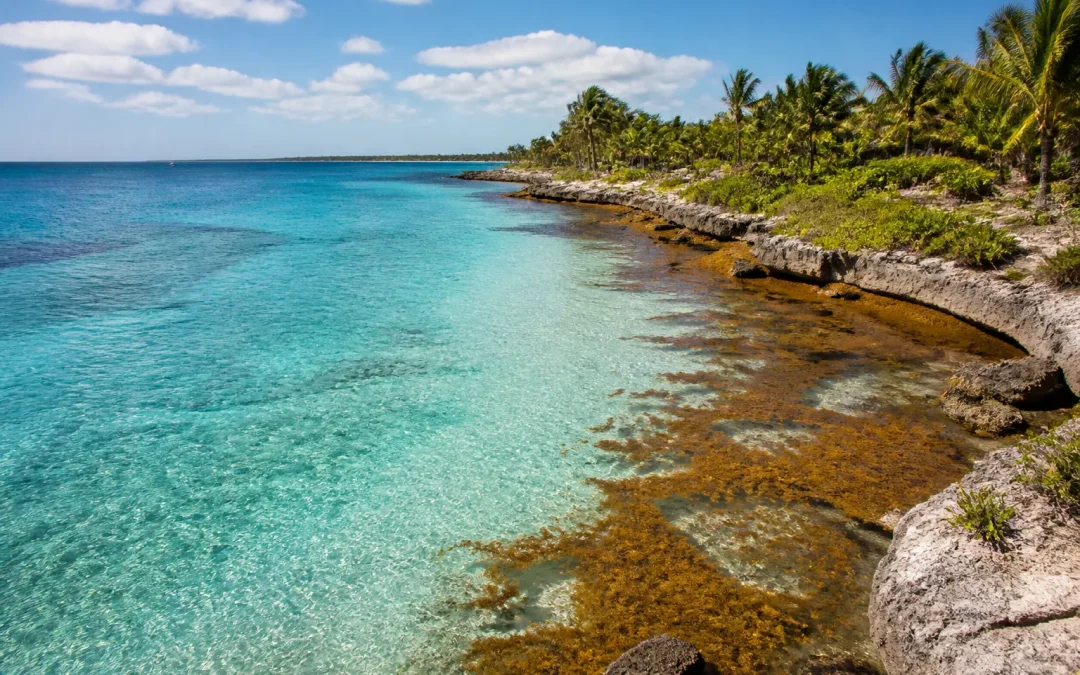
If you’re wondering whether Cozumel has sargassum in 2026, the short answer is yes – but conditions can be very different depending on which part of the island you visit.
Cozumel’s eastern coastline faces the open Caribbean and is generally more exposed to incoming floating sargassum. The western coastline faces toward the Yucatán mainland and is more sheltered, which is one reason many hotels, restaurants, beach clubs, snorkeling operators, and dive businesses are concentrated there.
The wider Caribbean is experiencing another major sargassum year. The University of South Florida’s July 31, 2026 Sargassum Outlook reported that although regional amounts began decreasing during July, the Gulf remained at a record high for July, while other monitored regions were second only to the 2025 record.
That does not mean every Cozumel beach has the same conditions.
The most useful question for travelers is not simply, “Does Cozumel have sargassum?” but:
“Which part of Cozumel has the best conditions during my visit?”
Is There Sargassum in Cozumel Right Now? [August 2026 Update]
Yes. Sargassum remains active across the wider Caribbean in August 2026, and Cozumel can receive significant accumulations at exposed locations.
According to the University of South Florida Optical Oceanography Laboratory, total sargassum across its monitored regions began declining in July, which is consistent with the seasonal pattern seen in many previous years. However, the Gulf still recorded its highest July level in the historical record, and Caribbean beaching events continued during the month.
USF’s July 31 outlook also states that 2026 is on track to be the second-largest sargassum year in its record, behind only 2025. The researchers expect regional amounts to continue declining during the coming months, potentially through November, although shoreline arrivals can still occur.
Cozumel has also experienced local accumulation. On July 19, 2026, the Municipality of Cozumel reported removing approximately 15 tons of sargassum from Chen Río during a cleanup involving approximately 600 participants.
For travelers, the important point is that regional abundance and conditions at an individual beach are not the same thing.
USF specifically cautions that its regional outlook should not be used to predict conditions at one specific beach.
| Area of Cozumel | Typical Exposure | Practical Expectation |
|---|---|---|
| West Coast | Generally lower | More sheltered; commonly used for swimming, snorkeling, diving, dining, and beach clubs |
| East Coast | Generally higher | More exposed to open-Caribbean arrivals; conditions can range from clear to substantial accumulation |
| Southwest Coast | Generally lower | Popular for snorkeling and diving; daily conditions still depend on wind, currents, and weather |
| Mexican Caribbean overall | Elevated in 2026 | Regional conditions do not predict every individual Cozumel beach |
No Cozumel beach can guarantee zero sargassum. Conditions can change with winds, currents, waves, storms, and the position of floating mats.
Why Does Sargassum Affect Some Parts of Cozumel More Than Others?
The main reason is geography combined with ocean and wind conditions.
Cozumel’s eastern coastline faces the open Caribbean, while the western coastline faces toward Playa del Carmen and the Yucatán mainland.
NOAA explains that sargassum inundation occurs when floating masses are transported toward shore by winds and ocean currents. Those factors can change from day to day, so the same stretch of coast may experience very different conditions within a relatively short period.
West Coast vs. East Coast Sargassum Conditions
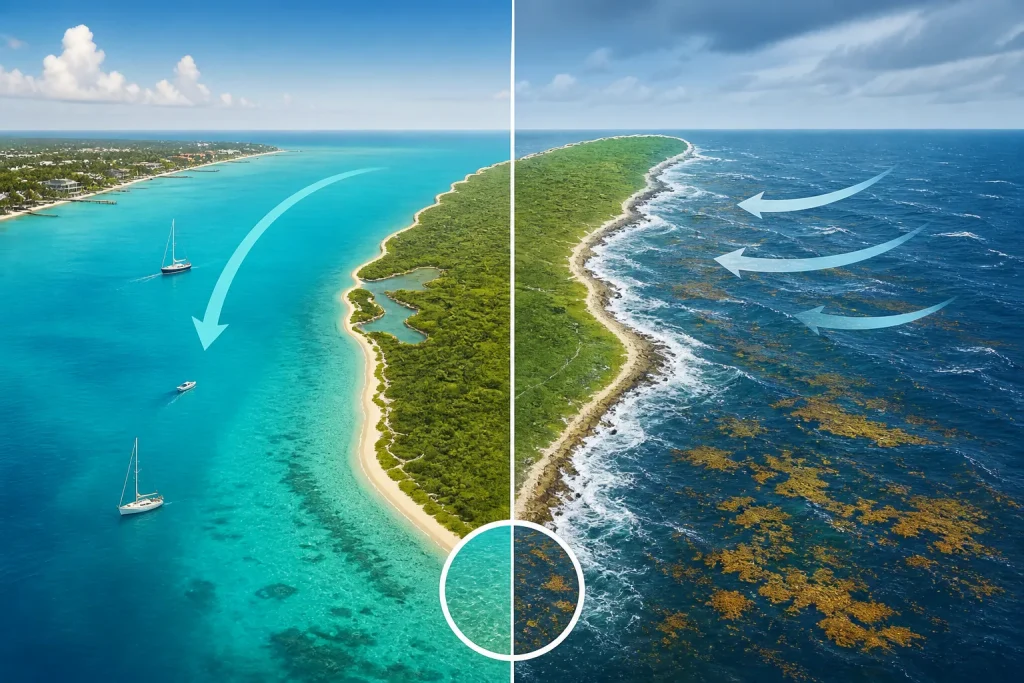
Cozumel conditions can differ sharply by coastline.
For visitors trying to reduce the chance of encountering a large accumulation, Cozumel’s coastline orientation is useful when choosing where to spend a beach day.
| Factor | West Coast | East Coast |
|---|---|---|
| Exposure | More sheltered | Faces the open Caribbean |
| Sargassum risk | Generally lower | Generally higher during active periods |
| Water conditions | Often calmer | Frequently rougher |
| Hotels and resorts | Many | Limited |
| Beach clubs | Many | Fewer developed facilities |
| Snorkeling and diving access | Extensive | More limited |
| Best suited for | Swimming, snorkeling, diving, dining, relaxed beach days | Scenic drives, natural beaches, photography, condition-dependent stops |
This does not mean the western coast is permanently sargassum-free.
Weather systems, unusual winds, currents, and local water movement can still bring floating material into normally sheltered areas.
Likewise, seeing a heavy accumulation on the east side does not mean snorkeling conditions on the west side will be the same.
What Actually is Sargassum?
Sargassum is a naturally occurring floating brown macroalgae found across parts of the Atlantic Ocean, Caribbean Sea, and Gulf.
Offshore, it is an important part of the marine ecosystem. NOAA explains that floating sargassum creates habitat for marine organisms, including fish, crabs, shrimp, and sea turtles.
Problems arise when exceptionally large quantities reach coastal waters and beaches.
According to NOAA’s Sargassum: From Sea to Shore resource, major inundations can:
- Affect coastal ecosystems.
- Interfere with tourism and recreation.
- Create dense nearshore accumulations.
- Reduce oxygen as stranded material decomposes.
- Affect coral, seagrass, and other marine habitats when accumulations become severe.
Large recurring sargassum events have affected the Caribbean since 2011, and scientists continue studying changes in ocean circulation, nutrients, temperature, and other environmental factors associated with these blooms.
Why is the 2026 Sargassum Season Getting So Much Attention?
The main reason is the unusually large regional amount of sargassum.
USF reported that although the overall amount began decreasing in July 2026, the Gulf still remained at a record high for July. Other monitored regions had less sargassum than the extraordinary 2025 peak but remained well above many historical years.
The July 31 bulletin concludes that 2026 is set to become the second-largest sargassum year in the satellite record, behind 2025.
For travelers, however, these regional figures require context.
The Caribbean monitoring area includes an enormous stretch of ocean and many destinations. Even within Quintana Roo, Cancún, Playa del Carmen, Tulum, Puerto Morelos, and Cozumel have different coastal orientations and local conditions.
A headline about a major Caribbean sargassum year therefore cannot tell you exactly what your Cozumel hotel beach, snorkeling location, or dive site will look like on a particular day.
When is Sargassum Season in Cozumel?
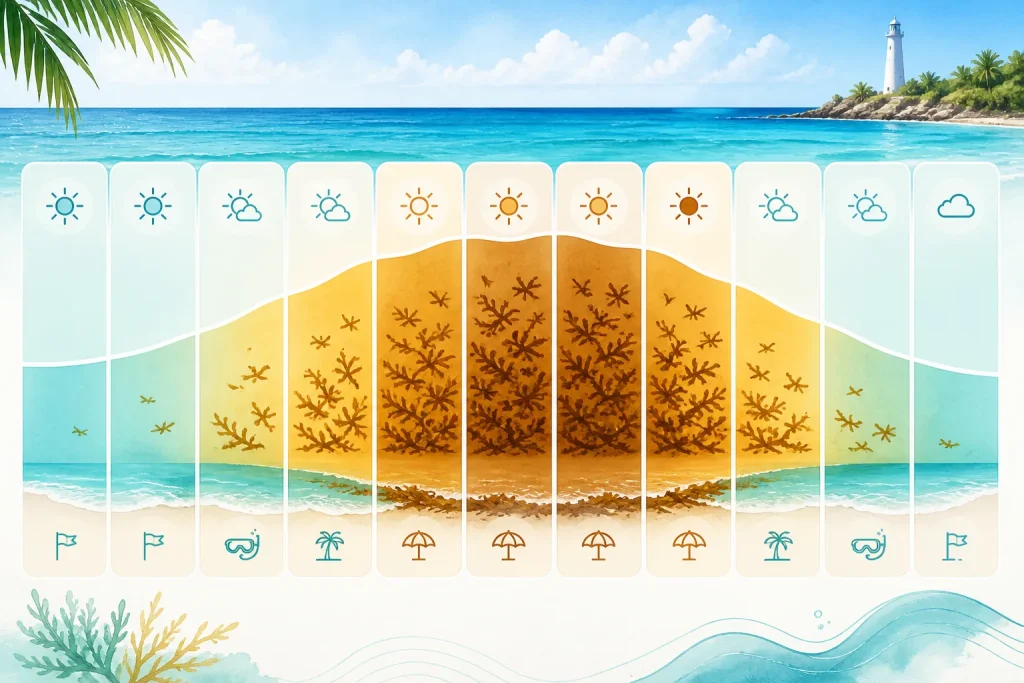
Seasonal patterns are useful for planning, but they are not guarantees.
There is no exact date when Cozumel’s sargassum season begins or ends.
Regional sargassum abundance changes throughout the year, and the intensity can vary considerably between seasons.
USF’s satellite monitoring shows that large Atlantic-Caribbean sargassum events commonly build during the first half of the year before declining later in the season. In its July 31, 2026 outlook, USF reported that amounts had begun decreasing and were expected to continue declining during the coming months, potentially through November.
A practical planning guide is:
| Month | General Regional Tendency | Cozumel Planning Advice |
|---|---|---|
| January | Usually lower | Typically less concern, but check local conditions |
| February | Usually lower | Good period for flexible beach planning |
| March | Can begin increasing | Start checking regional monitoring |
| April | Increasing possibility | Location becomes more important |
| May | Higher seasonal activity possible | Check conditions near your travel dates |
| June | Often highly active | Compare coastlines and recent reports |
| July | Typically active | Check current beach conditions |
| August | Can remain active | Same-week or same-day checks are useful |
| September | Variable | Stay flexible about beach location |
| October | Often declining but still possible | Continue monitoring before beach days |
| November | Usually reduced | Lower regional abundance is more common |
| December | Usually lower | Continue checking local weather and water conditions |
These are planning tendencies – not guarantees.
For a broader look at rainfall, seasonal weather, and travel conditions, see our Cozumel weather-by-month guide.
If you’re still choosing travel dates, our guide to the best time to visit Cozumel compares different parts of the year for diving, weather, crowds, and other travel considerations.
Why Can Cozumel Sargassum Conditions Change So Quickly?
Sargassum floats near the ocean surface, making its movement highly sensitive to changing environmental conditions.
According to NOAA, winds, currents, waves, and other coastal processes ultimately influence whether offshore sargassum reaches a particular shoreline.
That means:
- A beach with visible sargassum today may look different several days later.
- A clear beach can receive a new arrival.
- Two sides of the same island can have different conditions.
- A photograph from several weeks ago may no longer represent current conditions.
This is why travelers should put more weight on recent local information than photographs or reviews from months earlier.
How to Check Cozumel Sargassum Before Your Beach Day
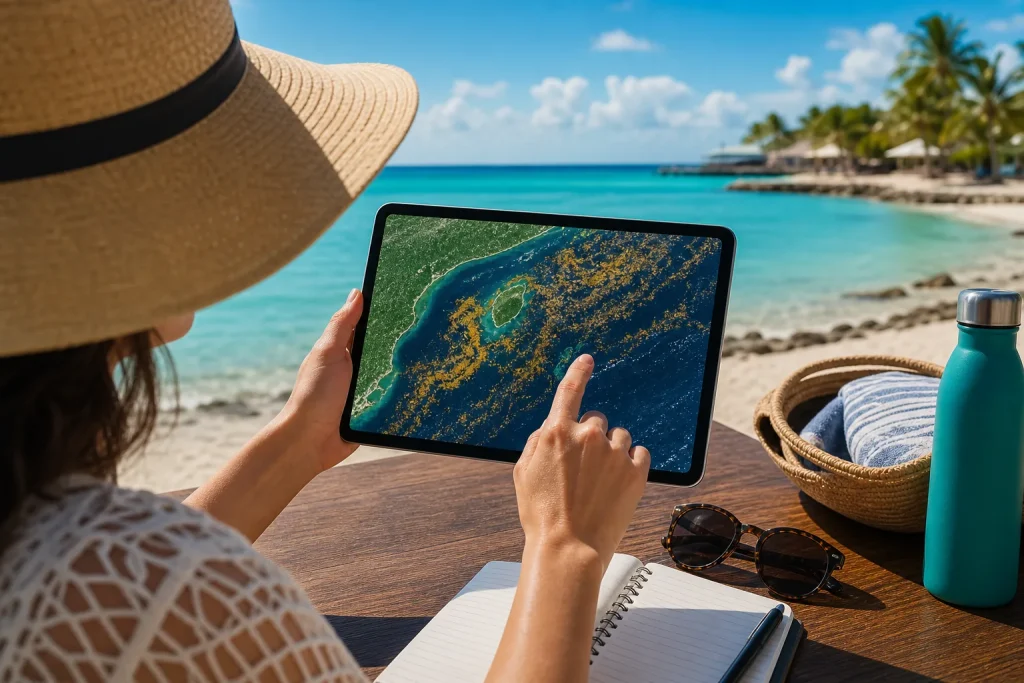
Use official monitoring plus recent local observations before choosing a beach.
For the most useful picture of current conditions, combine official regional monitoring with recent observations from the specific area you want to visit.
Check These Official Sargassum Sources
1. Secretaría de Marina – Daily Mexican Caribbean Bulletins : Mexico’s Secretaría de Marina publishes official daily monitoring bulletins through its Oceanographic Institute. Check the SEMAR daily sargassum bulletin archive for the latest available Mexican Caribbean outlook.
2. University of South Florida – Sargassum Watch System: The USF Sargassum Watch System provides satellite-based regional monitoring, monthly outlooks, and high-resolution imagery for selected regions. Use it to understand the broader regional situation, not to determine whether one particular beach is clear.
3. NOAA – Daily Sargassum Inundation Risk: NOAA upgraded its Sargassum Inundation Risk product in April 2026 to provide daily updates. The NOAA Daily Sargassum Inundation Risk tool identifies where satellite-observed sargassum may create a higher risk of coastal inundation.
Then compare those regional tools with:
- Recent local photographs.
- Hotel or beach-club updates.
- Dive and snorkeling operators.
- Current visitor reports.
- Conditions observed on the day of your activity.
If snorkeling or swimming is important to your trip, check again shortly before leaving for the beach.
Which Part of Cozumel Has Less Sargassum?
For most visitors concerned about heavy sargassum, the western coastline is the most practical place to start.
The west side is generally more sheltered and also provides easy access to many of Cozumel’s hotels, restaurants, beach clubs, snorkeling locations, and dive operators.
However, instead of searching for a supposedly permanent “sargassum-free beach in Cozumel,” look for a location that gives you flexibility.
A beachfront location with snorkeling, food, shade, and other activities gives you alternatives if water conditions are not ideal when you arrive.
Sunset Cozumel is located on Cozumel’s western coastline and provides direct water access along with dining and water activities. Visitors who want an easy-access water experience can learn more about our guided shore snorkeling tour in Cozumel.
The accurate description is more sheltered and generally lower-risk – not guaranteed sargassum-free.
Where Should You Stay in Cozumel If Sargassum Is a Concern?
If easy access to swimming and water activities is a priority, consider accommodation on or near the western coastline.
When comparing hotels, look beyond star rating and price. Check:
- Which side of the island the property is on.
- Which direction the swimming area faces.
- Whether the property provides recent beach-condition updates.
- Whether nearby alternative snorkeling or beach locations are easily accessible.
Even if your hotel is elsewhere, you can still choose the side of the island with better conditions for that day’s beach activities.
Does Sargassum Affect Snorkeling in Cozumel?
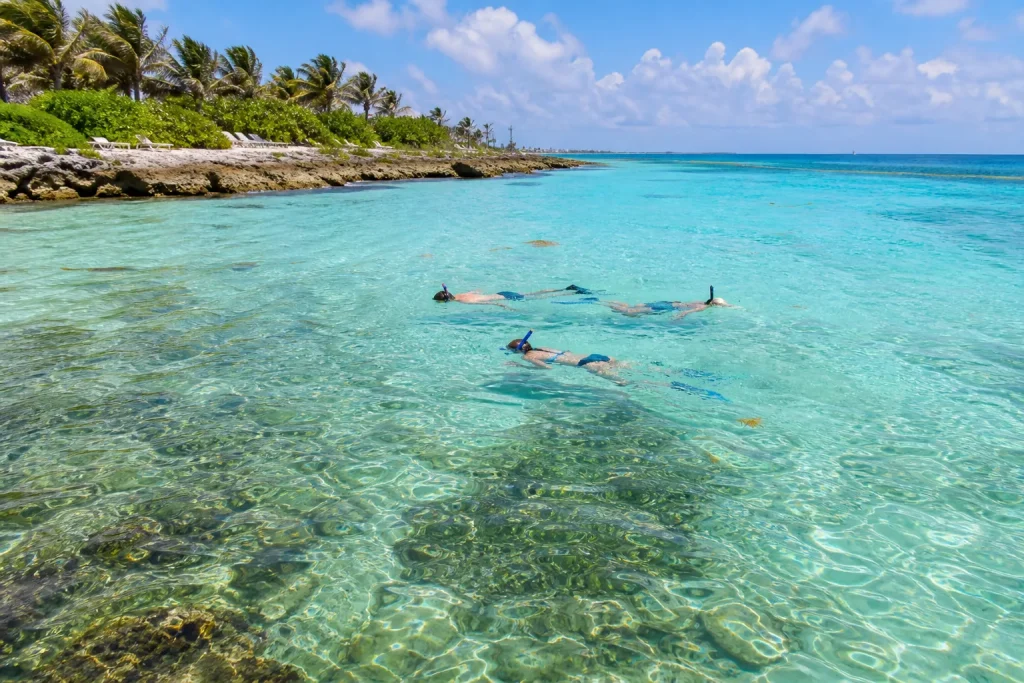
Snorkeling conditions should be checked by specific location and activity date.
Not necessarily.
Large accumulations are usually most noticeable at the shoreline and surface. Conditions at snorkeling sites can differ considerably depending on location, wind, current, visibility, and the amount of floating material present that day.
If you’re planning to snorkel, check:
- Surface conditions.
- Visibility.
- Wind and current.
- Ease of entering and exiting the water.
- Advice from your local operator.
Our guide to the best snorkeling spots in Cozumel can help you compare locations, while our Cozumel snorkeling safety guide covers water conditions and basic preparation.
A sargassum report from Tulum, Playa del Carmen, or even Cozumel’s east coast should not automatically be used to judge a west-side snorkeling site.
Does Sargassum Affect Scuba Diving in Cozumel?
Sargassum on a beach does not necessarily mean diving conditions at Cozumel’s offshore reefs are poor.
Divers are more concerned with:
- Surface conditions.
- Wind.
- Current.
- Visibility.
- Marine-park conditions.
- Safe boat operations.
Dense floating mats can occasionally affect surface navigation or entries, but underwater reef conditions may be different from what is visible on a beach.
If diving is a major part of your trip, check conditions directly with your dive operator. You can also explore our guide to the best scuba diving sites in Cozumel before choosing where to dive.
Cozumel vs. Playa del Carmen and Riviera Maya for Sargassum
Travelers often compare Cozumel with Playa del Carmen, Tulum, Cancún, and other mainland destinations during sargassum season.
The main difference is coastal orientation.
Large stretches of the Riviera Maya directly face the Caribbean. Cozumel also has an exposed Caribbean-facing east coast, but its western shoreline faces the mainland and offers travelers a different orientation without leaving the island.
| Question | Cozumel | Riviera Maya Mainland |
|---|---|---|
| Can sargassum occur? | Yes | Yes |
| Are all beaches equally affected? | No | No |
| Most exposed areas | Mainly east-facing coast | Many tourism beaches directly face Caribbean |
| More sheltered options | Western Cozumel | Depends on destination and beach |
| Best planning strategy | Compare current conditions by coast | Compare individual beaches |
This does not mean Cozumel will always have better conditions than every Riviera Maya beach.
The advantage is that different coastal orientations are available on the same island.
Is Sargassum Dangerous?
Sargassum itself is naturally present in the ocean, but large decomposing accumulations on shore can create health concerns.
According to the NOAA Sargassum FAQ, decomposing sargassum releases hydrogen sulfide, a gas that may cause respiratory health problems.
NOAA also notes that heavy coastal inundations can affect local air quality and coastal ecosystems.
If you encounter a beach with a large decomposing accumulation and a strong rotten-egg smell:
- Avoid spending long periods immediately beside it.
- Move away if you experience eye, nose, throat, or breathing irritation.
- Travelers with respiratory conditions should be particularly cautious.
- Follow local beach and public-health guidance.
The important distinction is between floating sargassum offshore and large accumulations decomposing on land.
How to Plan a Cozumel Trip During Sargassum Season
You do not need to organize your entire Cozumel vacation around sargassum.
A better strategy is to remain flexible.
- Check recent conditions. Do not rely on a photo or review from several weeks earlier.
- Compare different parts of the island. If an exposed beach is experiencing heavy accumulation, check a more sheltered location.
- Ask local operators. Snorkeling and diving businesses see the water every day and can provide information relevant to their specific site.
- Choose flexible beach-day locations. Food, snorkeling, diving, shade, and other activities give you alternatives if water conditions change.
- Have a backup activity. Cozumel offers dining, sightseeing, diving, snorkeling, cultural attractions, and other activities beyond one particular beach.
Cruise passengers can apply the same approach. Our Cozumel shore excursions guide can help you compare beach and water-activity options without assuming that one sargassum report describes the entire island.
For more alternatives, see our complete guide to things to do in Cozumel.
Is Cozumel Still Worth Visiting During Sargassum Season in 2026?
Yes – with realistic expectations and flexible planning.
The wider Caribbean is experiencing another unusually large sargassum year. USF expects 2026 to rank behind only 2025 in its historical record, and Cozumel has experienced significant local accumulations at locations such as Chen Río.
But Cozumel should not be treated as one uniform beach.
The island has:
- Different coastal orientations.
- Sheltered and exposed areas.
- Numerous snorkeling and diving locations.
- Beach clubs and restaurants.
- Activities that do not depend entirely on one beach.
Rather than cancelling a trip based on a broad regional headline, check the specific part of Cozumel you intend to visit.
For a beach or water-activity day, the most useful question remains:
“Where are the best conditions on Cozumel today?”
Sargassum in Cozumel FAQs
Is there sargassum in Cozumel right now?
Yes, sargassum remains present across the wider Caribbean in August 2026, and Cozumel can receive it. However, conditions differ by location and can change quickly. Use SEMAR, USF, NOAA, and recent local reports to check the specific area you plan to visit.
Is Cozumel affected by sargassum in 2026?
Yes. The Municipality of Cozumel reported removing approximately 15 tons of sargassum from Chen Río on July 19, 2026. That local event does not mean every Cozumel beach was experiencing the same conditions.
Which side of Cozumel gets the most sargassum?
The eastern side is generally more exposed to floating material arriving across the Caribbean. Conditions depend on winds and currents, so the exact amount can change from day to day.
Which side of Cozumel has less sargassum?
The western coastline is generally more sheltered and typically presents a lower risk of major accumulation than exposed east-facing beaches. No location can guarantee zero sargassum.
What months are worst for sargassum in Cozumel?
Regional sargassum activity commonly increases during spring and summer, but timing varies between years. USF reported that 2026 amounts began declining during July and are expected to continue decreasing during the following months.
Will Cozumel have sargassum in September 2026?
It is possible. USF expects regional amounts to decline after the summer peak, but beaching events can still occur. Check official monitoring and recent local observations close to your travel date.
Will Cozumel have sargassum in October 2026?
Sargassum may still occur in October. USF’s July 2026 outlook expects regional abundance to continue declining in the coming months, potentially through November, rather than disappearing on a fixed date.
Is Cozumel completely sargassum-free?
No. No Cozumel beach can guarantee zero sargassum. The island’s advantage is that its different coastlines can experience different conditions.
Is sargassum dangerous to swim around?
Small amounts of floating sargassum are naturally present in the marine environment. The greater health concern is large quantities decomposing on shore, which can release hydrogen sulfide and affect air quality.
Does sargassum ruin snorkeling in Cozumel?
Not necessarily. Beach accumulation at one location does not automatically represent conditions at every snorkeling site. Check water conditions with your operator on the day of the activity.
Should I cancel my Cozumel trip because of sargassum?
A regional sargassum report alone is usually not enough to judge the entire island. Check individual beaches, remain flexible, and favor locations with better current conditions.
Final Takeaway: Check the Coast, Not Just “Cozumel”
Sargassum is a genuine concern across the Caribbean in 2026, but Cozumel should not be treated as one uniform coastline.
The eastern side is generally more exposed to incoming sargassum, while the western side is more sheltered and gives visitors more options for swimming, snorkeling, diving, dining, and beach activities.
For the best experience:
Check official monitoring close to your travel date, compare conditions at specific locations, and keep your plans flexible.
If you’re looking for a west-side location where you can combine Caribbean views, food, drinks, shore snorkeling, and diving, explore the guided shore snorkeling experience at Sunset Cozumel and confirm current water conditions before your visit.